
African Safaris by Ismail
This web page has been put up in the hopes of attracting people who are interested in really trekking in Africa, in going on a safari like it was fifty years ago.
 
Safaris today are canned, packaged, and generally offer no aspect of adventure whatsoever. If you have two weeks in Africa, and don't have time to spend putting together a real safari, then these safaris offer a way to see the wildlife and people (to some scant and usually staged degree) that one wouldn't have otherwise. But if what you are after is to go to Africa and experience Africa, for all it's beauty, enormity and differences, then read on.


I first went to the Suguta Valley and Lake Turkana in Northern Kenya in 1996. How I ended up there, and the whole story of that trip can be found in this document. That web page and document is dedicated to the first trip that I made to Lake Turkana.
 
Ismail, the guide whom I have used for all my trips, (my partner Carol and I traveled there in mid-August of 1998, and I just returned from my 3rd trip in September of 2003), is the person who this page is really for. Ismail is trying to make his livelihood by taking people through an area of the world that he both knows and loves. He is a good friend and an incredible guide, and so this page is here to engage your interest to the point that you want to go off to Kenya and explore that part of the world with him as your guide.
 
Ismail lives in Maralal, in Northern Kenya. Maralal is in a small valley surrounded by hills in which the Samburu people live. Maralal is the last outpost going north in that part of the country. It is the last bank and the last town with electricity. Transport is in and out daily to Nyahururu to the south-west, and Isiolo to the south-east, but is hard to get up north, and can take a few days of waiting. This is where he bases his safaris from. If the safaris are into the surrounding hills to see the Samburu people, then the trips start from Maralal. If the destination is Lake Turkana, then it is about a 6 hour ride up to Baragoi, and the walking starts from there. (see map of the area)
 
I haven't said much about the safaris yet. Ismail leads two main types of safaris, and they are mainly all on foot. The first is into the surrounding hills to visit and get to know the local Samburu people. On my first trip with Ismail we did a 3 day walk into the hills around Maralal, going from Samburu village to village, and we carried our own gear and a little food. These safaris are relatively easy, the weather and the terrain aren't extreme, and so the physical demand isn't high. We met, talked with, and once even stayed in the home of some of the villagers, getting to know them and their way of life along the way. It was an incredible glimpse into a way of life that has been around for millennium, and prompted me to do my second safari with Ismail, the safari to Lake Turkana.
 
These safaris are wonderful in that the terrain is lush and diverse, green and almost subtropical. Incredible views from the escarpment into the valley below makes you feel like you are at the end of the world. The Samburu are a very open people, and usually more educated, so you will find even your warriors in full traditional dress who speak English, and so you can converse with. They are hospitable and friendly, and have not resisted the onslaught of western culture as the Massai have, and so there is an interesting mixture of the two. These are wonderful trips, usually shorter in duration, but in the end, the length is up to you.
 
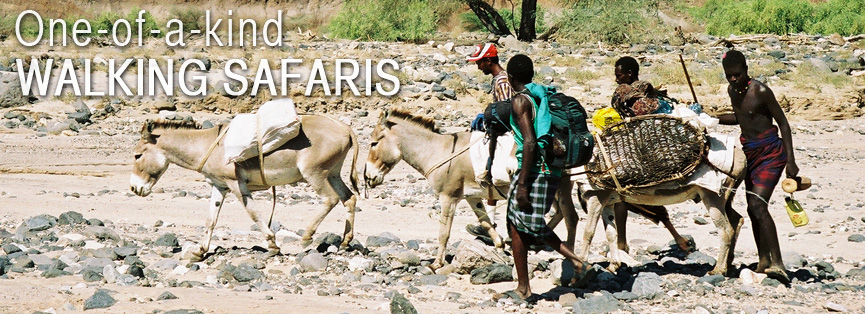
The safaris to Lake Turkana however, are something different. It is about 7-12 days of walking, depending on how fast you walk and how many detours you take. Six ten liter gerry cans are carried for water, and are filled at every opportunity. In these Safaris, you are out there! There are no roads, no electricity, no tourists. On our trip in August of'98, we were told that we were the first white people in the Suguta Valley in over a year. Out there, you rely on yourself, your wit, and instinct. And you rely on Ismail. This is an area of the world that you don't go into by yourself unless you have been in the bush for years. The Suguta Valley and Lake Turkana are described as one of if not the harshest terrains on the planet. It is described as the hottest and windiest place on earth. That should say a lot.
 
It is also one of the most fascinating places I have ever seen, hence my three journeys there and the plan for more. The above web page will give a better account than I want to put here, but this is a quick description. It is ancient volcanic, where in the dry season the temperatures can reach 50-55 Centigrade, 120-130 Fahrenheit, during the day. The wind, which is usually very consistent, kicks up at night and gusts at velocities of which I could only guess. Suffice it to say that we used numerous 10-15 pound rocks to hold our mosquito net/tent to the ground. Lake Turkana itself is an incredible sight. An ancient sea that gives off a jade glow at the right time of the day and year, is an anomaly out there in that incredible desert. Nile perch, the largest concentration of crocodiles in the world, it is amazing, truly amazing. And then there are the Turkana people. They are like the Masai in that they are very prideful, and have little or no interest in anything from the outside influencing their culture. Yet they are open and friendly and interested in who you are and what you are doing there. They are a wonderful, fun, yet reserved people. Between the Turkana people and being at the lake, it is an adventure like nothing I have ever done before.
 
Ismail as your guide will take you through this land. He and Lochuch, the man whose donkeys we use when we travel there, are from there and have done the journey countless times, mostly carrying goods to trade. Ismail is also reserved, but quick to laugh and give as much information about where you are and what is going on as you want to ask for, depending on you and what you want. He will lead you through the land, introduce you to the people, silently pay off warriors to guard you at night, make sure that you aren't unknowingly wandering into a raid or skirmish between tribes, and get fresh cow, goat or camel milk for tea. He handles the cooking, although we almost always pitch in, because it's fun. He makes sure you find water, arranges trades with people for goods and food, and makes sure the places that you spend the night are safe and comfortable, (well, as comfortable as can be in a volcanic desert!). Simply put, he takes you places you would have a hard time staying alive in yourself. And he does it because he loves it.
 
If this has indeed piqued your interest enough to want to know more, e-mail me at the address below, and I will get you in touch with Ismail. Keep in mind though, that the Turkana safari is not a picnic, this isn't a guided stroll through the African bush with a cold beer waiting for you at the end of the day, (although the Oasis Lodge in Loyangolani, the end point of our journey, does have cold beer!). It is one of the most difficult things I have ever done in my life, and at times took everything I had to overcome the exhaustion and heat to keep on walking. And every single step was worth it!
For more information contact Mickey Mestel at mickm@carmick.com
 
Maps and Related Links
 

Art Works Studio Website Design donated by
Art Works Studio

©1998 Mickey Mestel